
Why CFOs need a different lens on cloud spend
Cloud spend has graduated from "an IT line item" to "one of the largest variable costs on the P&L" in under a decade. Finance teams who treated it as a fixed infrastructure cost a few years ago now face a number that moves daily, scales with revenue, and rarely arrives with a clean explanation of why it moved.
The capabilities below are the ones we see CFOs reach for most often when they decide to take cloud cost seriously. None of them require buying a new platform first — they're operating disciplines that benefit from tooling, not the other way around.
1. Visibility — see where the money actually goes
The first capability is the most underrated: real, granular visibility into where cloud spend is going. Not the AWS or Azure summary screens — those tell you what each service cost. CFOs need a different cut: spend by team, product, environment, customer, and time period, with every dollar traceable to the system that produced it.
When this works, every cost on the bill answers two questions: who is using this? and why? Until those two answers exist for every dollar, optimization conversations devolve into guesswork.
Most finance teams underestimate how much of their bill is unattributed when they start. A 30–40% "unallocated" bucket is normal in month one; getting it below 5% is achievable in 8–12 weeks with a tagging discipline applied at provisioning time.
2. Segmenting and tagging cloud costs to the general ledger
Visibility is the input; tying it back to the GL is what turns it into financial reporting. Without segmentation, you can produce a detailed cloud cost report — and your controller still won't know which cost center it should sit in.
The capability finance teams need is a consistent allocation framework that maps cloud cost dimensions (account, subscription, project, tag) to GL dimensions (cost center, business unit, product line). It's mechanical work, but once it exists, cloud cost can finally show up in a per-product P&L that includes infrastructure as a real input instead of a back-of-envelope estimate.
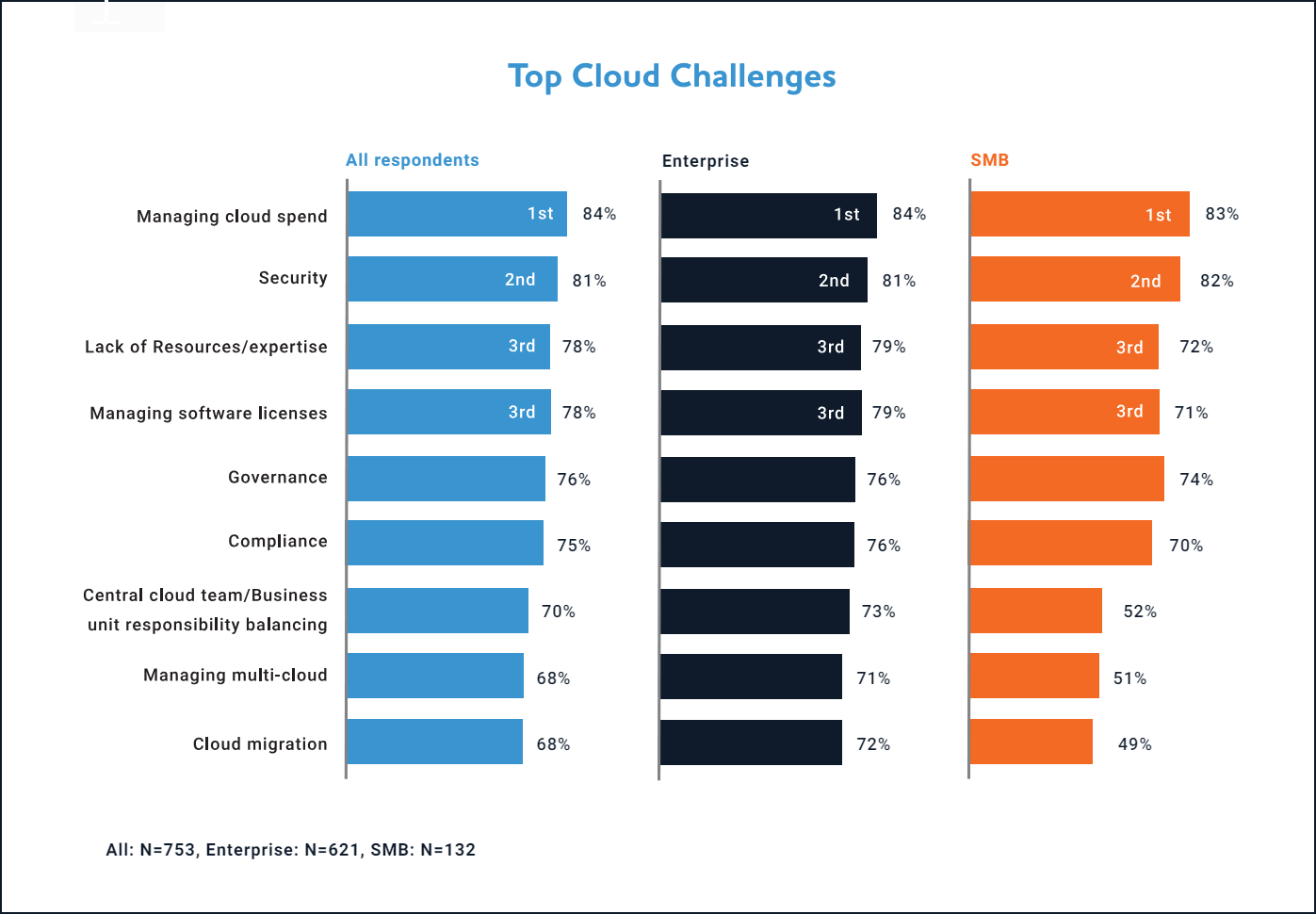
"84% of cloud decision-makers identify managing cloud spend as their primary challenge" — Flexera 2024 State of the Cloud Report.
That number is high because the foundation — getting cloud cost into the financial reporting stack the rest of the company already uses — has been hard. It doesn't have to be.
3. A common framework for collaborating with engineering
Cloud cost decisions are joint decisions. Engineering knows what they're running and why. Finance knows what the business can afford. Neither half can act alone, and most overruns happen in the space between the two views.
The capability here isn't a meeting cadence — it's a shared metric set. Pick a small number of measurements both sides will treat as authoritative: cloud spend per active customer, per pipeline, per environment, per release. Publish them on a regular cadence. Let engineering opt into accountability by labeling their work; let finance opt into context by showing the business impact attached to each dollar.
FinOps frameworks (the discipline, not the marketing label) exist precisely to give both sides a shared vocabulary. The teams that adopt them well treat them as operating models, not platforms — the platform comes second.
4. AI-assisted optimization of cloud spend
The volume of decisions involved in managing modern cloud spend has outpaced what any human team can handle manually. A mid-market business runs millions of usage events per month across thousands of resources, and the optimization signals are buried in patterns that take continuous attention to spot.
This is the natural job for machine-assisted analysis: surface idle resources, recommend rightsized instance families, detect anomalies before they become budget hits, and flag commitments that are no longer matched to their underlying workload. The capability finance teams need isn't "AI" as a buzzword — it's a continuous, automated review layer that frees humans to make the decisions that actually require judgment.
Used well, these recommendations recover 10–25% of cloud spend with minimal disruption. The trick is reviewing them in batches and trusting the system enough to act, not letting them stack up in a ticket queue forever.
5. Tools to select and manage discount programs
The fifth capability is the one most CFOs end up wishing they'd built first: a disciplined approach to cloud discount programs. Savings Plans, Reserved Instances, committed-use discounts, enterprise agreements — every cloud provider has at least four or five ways to discount your bill, and they all reward the same thing: commitment matched to workload.
Done well, the discount portfolio recovers 10–30% of compute spend. Done poorly — bought reactively whenever a provider AE suggests it — it produces idle commitments that cost more than they save.
The capability finance teams need is portfolio management discipline applied to commitments: a monthly review of coverage, utilization, and effective discount, with a clear policy for renewing, expanding, or contracting commitments based on actual workload trajectory.
For a deeper walkthrough of this specific capability, see our companion article on mastering cloud FinOps discount programs.
Use case: what this looks like in practice
A cybersecurity company we worked with was spending roughly $15 million per year on cloud and couldn't tell their CFO which products were profitable. They started with the five capabilities above — visibility, segmentation, the engineering framework, AI-assisted optimization, and a commitment portfolio — and applied them sequentially.
Three months later:
- Unallocated spend dropped from ~40% of the bill to under 5%.
- Reserved Instance coverage moved from ~20% to over 70%.
- Forecast accuracy improved from a roughly 25% miss to under 8%.
- Annualized savings: roughly $3 million.
You can read the full account in our case study.
The advantage of a cloud financial management platform
You can stand up these five capabilities with spreadsheets, hand-built dashboards, and a determined finance lead. Many companies do. The breakpoint is usually around $1–2 million in annual cloud spend, or when you cross a second cloud provider — past that, the manual coordination cost overtakes the savings.
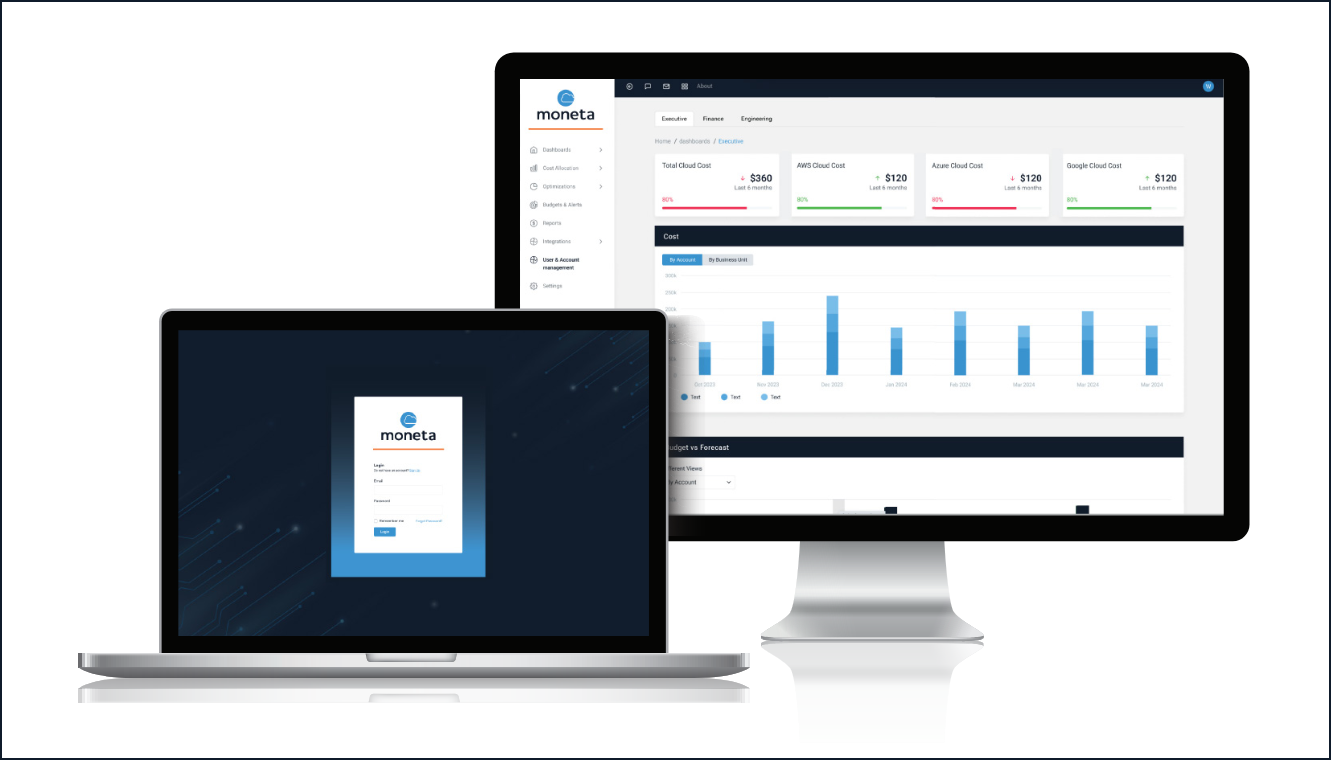
This is where a cloud financial management platform earns its keep. The job of the platform isn't to replace the operating disciplines above — it's to make them sustainable at scale, so the finance team can spend its time interpreting the numbers instead of assembling them.
If you want to walk through how moneta approaches each of the five capabilities, our team is happy to do that with your own numbers. You'll know inside thirty minutes whether the platform fits.